Quoin / Est. 2014 / Two Heidelbergs
Ink, pressed into paper hard enough to feel.
Everything here is printed one colour at a time on a machine built before either of us was born. You can feel the impression with a thumbnail, which is the entire reason anybody pays four times the digital price for it.
Get a quoteConcept work — fictional brand, built to demonstrate technique. Nothing is for sale.
A digital press puts ink on top of paper. A letterpress puts it into the paper, and leaves a dent you can read with your eyes shut. Everything else about this trade — the cost, the lead time, the four separate passes — is the price of that one difference.
Letterpress printing
It runs at the speed you scroll
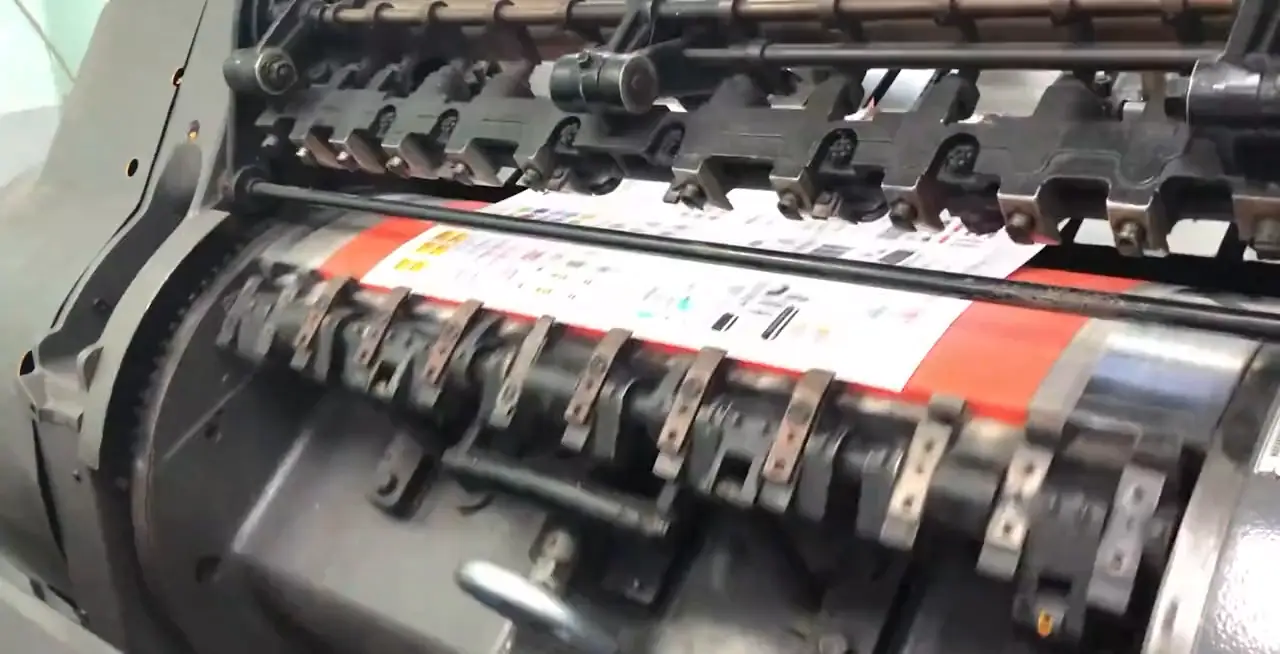
Scroll and the press turns. Stop and it stops. This is the ink train on the smaller of the two machines — nine rollers moving ink from the duct to the forme, and the reason a letterpress takes twenty minutes to make ready and ninety seconds to print two hundred.
Four passes, four days
Every colour is a separate trip through the machine, and the paper has to dry between them. Scroll to put them on one at a time. Registration is done by eye against a pin — which is why the fourth pass is always the smallest one, and why nobody sensible designs a letterpress job with four.
- 1. Warm greyMondayPantone Cool Gray 9The ground. Largest area, lightest touch, printed first so everything after it registers to something.
- 2. VermilionTuesdayPantone 179The one people remember. Mixed by hand on a slab from rubine and yellow, and never quite the same twice.
- 3. Deep blueThursdayPantone 2965Over the grey, under the black. Two days after the vermilion because a heavy solid needs longer than a line.
- 4. BlackFridayRich black, 3mm deepThe type, last and deepest. A 3mm impression in 600gsm, which is about as far as the paper will go before it splits.
What it goes on
Five stocks, all cotton, all made for this. The number is the weight in grams per square metre and it is the only number that matters: under 300 the impression shows through the back, and over 600 the guillotine starts to argue.
300 gsm
Gmund Cotton
Off-white, soft. The default and the cheapest. Impression shows faintly on the reverse.
Point at a sheet to pull it out.
- Gmund Cotton, 300 gsm
- Off-white, soft. The default and the cheapest. Impression shows faintly on the reverse.
- Crane Lettra, 450 gsm
- Pearl white, very soft, takes the deepest impression of anything here.
- Colorplan, 540 gsm
- Ebony. Ink barely shows, so this one is for blind deboss and foil only.
- Duplexed Lettra, 600 gsm
- Two 300s glued face to face with a coloured seam down the edge. Twice the price and worth it once.
- Board, dyed, 640 gsm
- Terracotta through the whole thickness. The edge is the point; do not trim it square.
The shop
- 2
- Presses
- 1100/hr
- Impressions, one colour
- 20 min
- Make-ready, per pass
- 3mm
- Deepest impression
Why a hundred costs nearly as much as five hundred
Almost all of the cost is in the setup: the plate, the make-ready, the wash-up between colours. The printing itself is ninety seconds. That is why the per-card price falls off a cliff and then flattens, and why we will politely talk you out of ordering fifty.
| Quantity | One colour | Two colours | Each |
|---|---|---|---|
| 50 cards | £210 | £340 | £4.20 |
| 100 cards | £245 | £385 | £2.45 |
| 250 cards | £330 | £495 | £1.32 |
| 500 cards | £460 | £670 | £0.92 |
| 1,000 cards | £690 | £980 | £0.69 |
| 2,500 cards | £1,340 | £1,880 | £0.54 |
Before the plates
Send us the artwork and we will tell you what is wrong with it
Hairlines under 0.4pt fill in. Large solids show roller marks. Four colours means four days and three chances to mis-register. None of that is a reason not to do it — it is a reason to hear it before the plates are made.
Send artworkConcept work — fictional brand, built to demonstrate technique. Nothing is for sale.